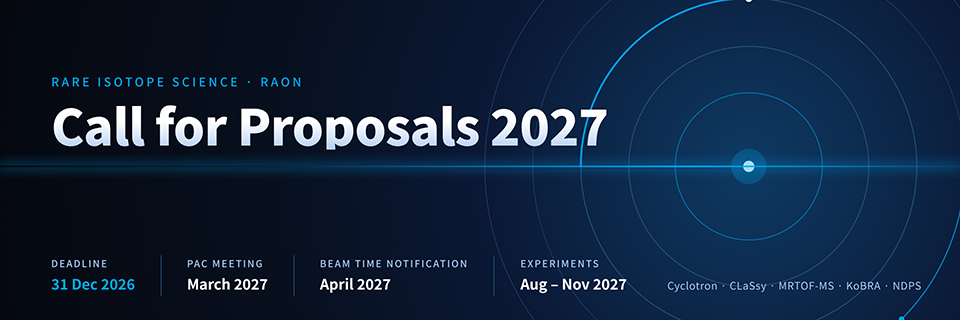
CALL FOR PROPOSALS 2027
The Institute for Rare Isotope Science (IRIS) invites proposals for beam time from domestic users in Korea for experiments at RAON. Approved proposals are expected to be conducted during the RAON beam time campaign scheduled for 2027.Beam time is expected to become available starting in August 2027.
1. Available Beams and Experimental Facilities
The beams listed below are expected to be available for experiments at RAON. Beam availability, energy, intensity, and other operating parameters may very depending on commissioning status and experimental conditions. In particular, some beams require further commissioning or confirmation of their derailed specifications.
1.1. Very Low-Energy Beams
Rare Isotope (RI) beams
Rare Isotope (RI) beams at energies of up to 20 keV are expected to be available from ISOL. The expected intensities and relevant conditions are summarized below.
|
Isotope |
Expected intensity @ISOL |
Note |
|
Li-8 |
Up to 104 pps |
Charge breeding would be difficult. |
|
Li-9 |
Up to 102 pps |
Charge breeding would be difficult. |
|
Na-20 |
Up to 104 pps |
- |
|
Na-26 |
Up to 104 pps |
- |
|
Na-21 |
Up to 106 pps |
- |
|
Na-25 |
Up to 106 pps |
- |
|
Na-22 |
Up to 108 pps |
- |
|
Na-24 |
Up to 107 pps |
- |
|
Mg-22 |
Up to 105 pps |
contaminated with Na22 |
|
Mg-23 |
Up to 107 pps |
contaminated with Na23 |
|
Mg-27 |
Up to 105 pps |
contaminated with Al27 |
|
Al-25 |
Up to 106 pps |
contaminated with Na25 |
|
Al-26 |
Up to 107 pps |
contaminated with Mg26 and Na26 |
|
Al-28 |
Up to 104 pps |
- |
|
Al-29 |
Up to 103 pps |
- |
|
Ba-133 |
Up to 106 pps |
contaminated with Ba133m and Cs133 |
|
Ba-133m |
Up to 106 pps |
contaminated with Ba133 and Cs133 |
|
Cs-134 |
Up to 106 pps |
contaminated with Cs134m and Ba134 |
|
Cs-134m |
Up to 106 pps |
contaminated with Cs134 and Ba134 |
|
Cs-135m |
Up to 105 pps |
contaminated with Cs135 and Ba135 |
|
Cs-136 |
Up to 106 pps |
contaminated with Cs136m and Ba136 |
|
Cs-136m |
Up to 105 pps |
contaminated with Cs136 and Ba136 |
Additional beams under development
|
Isotope |
Expected intensity @ISOL |
Note |
|---|---|---|
|
Rb |
TBD |
Development of ISOL target is required. |
|
K |
TBD |
- |
|
Ar |
TBD |
Isobaric contamination needs to be investigated. |
Stable Isotope (SI) beams
Stable Isotope (SI) beams at energies of up to 20 keV and proton beams at energies of 40 - 70 MeV are also expected to be available from ISOL. The expected intensities and relevant conditions are summarized below.
| Isotope | Energy | Expected Intensity @ISOL | Note |
| Li-6,7 | up to 20keV | Up to 107 pps | Charge breeding would be difficult |
| Na-23 | Up to 107 pps | - | |
| Mg-24,25,26 | Up to 107 pps | Contaminated with Na-24,25 | |
| Al-27 | Up to 107 pps | - | |
| K-39,41 | Up to 107 pps | - | |
| Proton | 40-70 MeV | 10W to 100W | Cyclotron Vault |
1.2. Low-Energy Beams
Beams delivered through EBIS
The following Stable isotope (SI) and rare isotope (RI) beams are expected to be available at energies of up to the maximum values specified below.
| Isotope | SI/RI |
Energy (Maximum) |
Expected Intensity @EBIS | Note |
|---|---|---|---|---|
| Ne-20 | SI | 20 MeV/u |
Up to 1010 pps (~ 102 particle/ns) |
beam power up to 4 W beam duty up to 50% attenuator = 10-2 ~ 10-8 |
| Ne-22 | SI | 25MeV/u | ||
| Ar-40 | SI | 23 MeV/u | ||
| Na-21,25 | RI | Up to 20 MeV/u | Up to 105 pps |
Transmission (EBIS to KoBRA F0) ~ 50 % Beam size(F0, RMS) ~ +- 1.5 mm |
| Na-22,24 | RI | Up to 107 pps | ||
| Na-23 | SI | Up to 107 pps | ||
| Mg-22 | RI | Up to 104 pps | ||
| Mg-23 | RI | Up to 106 pps | ||
| Mg-24,25,26 | SI | Up to 107pps | ||
| Mg-27 | RI | Up to 105 pps | ||
| Al-25 | RI | Up to 105 pps | ||
| Al-26 | RI | Up to 106 pps |
Beams delivered through SCL3
Additional Stable isotope beams may become available following further commissioning and test runs.
| Isotope | Energy | Expected Intensity @SCL3 |
|---|---|---|
| Kr | Up to 20 MeV/u | TBD |
| Xe |
* The availability and detailed specifications of these beams will be confirmed following further commissioning and test runs.
The availability and detailed specifications of these beams will be confirmed following further commissioning and test runs.
1.3. Available Experimental Setups
The following experimental setups will be available for approved experiments, subject to operational readiness and scheduling:
-
KoBRA
-
NDPS
-
CLaSsy
-
MRTOF-MS
-
Cyclotron
Users interested in these facilities or requiring further information about beam characteristics and experimental feasibility are encouraged to contact the IRIS team at user_support@ibs.re.kr.
2. Proposal Submission and Review
Proposals must be submitted by December 31, 2026, to allow sufficient time for scientific and technical reviews before the Program Advisory Committee (PAC) meeting scheduled for March 2027.
Beam time will be allocated to non-proprietary experiments based on their scientific merit, as evaluated by the PAC.
There will be no beam time charge for non-proprietary experiments, provided that the results are expected to be published in scientific publications.
3. Important Dates
-
October 22, 2026: Call for proposals
-
December 31, 2026: Proposal submission deadline
-
March 2027: PAC meeting
-
April 2027: Notification of approved experiments
-
August–November 2027: Planned experimental period using SCL3 beams, subject to operational readiness
-
Proton and low-energy ISOL RIB experiments: Beam time scheduling will be arranged individually in consultation with the IRIS team.
4. Proposal Submission Guidelines
The contact spokesperson for each proposal must register on the IBS Indico website and complete the online submission form.
Registration and submission: https://indico.ibs.re.kr/e/user
Proposals must meet the following requirements:
-
Maximum length: 10 pages, including the cover page, references, tables, and figures
-
Font: Times New Roman or Calibri
-
Font size: 12 point
Proposals will be treated confidentially and made available only to PAC members and relevant IRIS staff for scientific, technical, and safety reviews.
For technical inquiries regarding beam availability, beam specifications, or experimental setups, please contact user_support@ibs.re.kr
