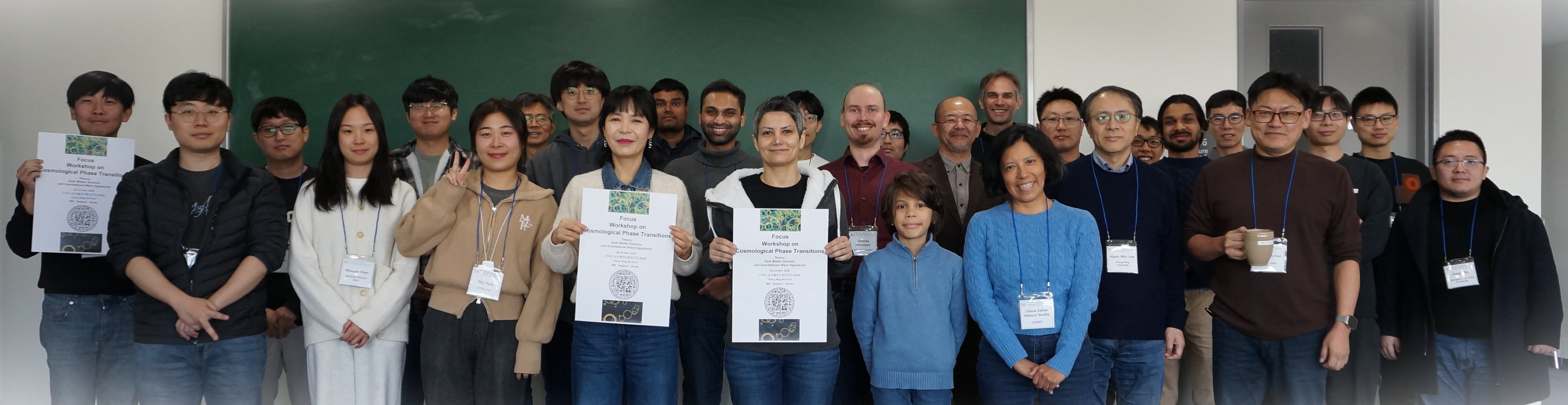
Focus Workshop on Cosmological Phase Transitions: Theory, Dark Matter Genesis, and Gravitational Wave Signatures

Asia/Seoul
IBS, Daejeon

IBS, Daejeon

Description

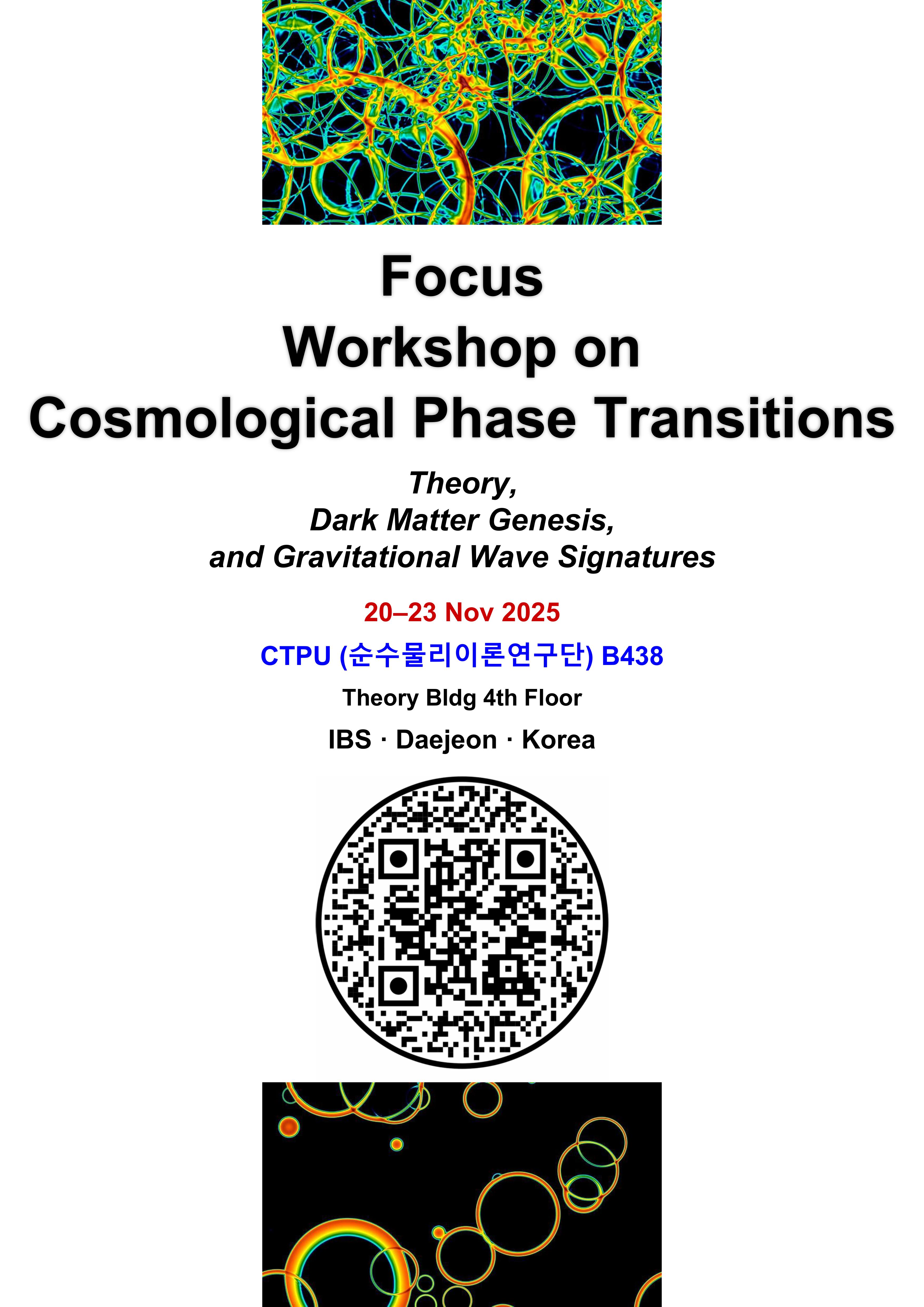
Focus Workshop on Cosmological Phase Transitions

Theory, Dark Matter Genesis, and Gravitational Wave Signatures

20–23 November 2025 · IBS · Daejeon · Korea


Overview

The Focus Workshop on Cosmological Phase Transitions: Theory, Dark Matter Genesis, and Gravitational Wave Signatures brings together leading experts to explore one of the most fascinating frontiers in modern particle physics and cosmology. This intensive workshop will focus on the theoretical foundations of cosmological phase transitions in the early universe, examining how these fundamental processes may have generated the dark matter that dominates our cosmos today and produced detectable gravitational wave signatures that could revolutionize our understanding of the universe's earliest moments. Through in-depth presentations and collaborative discussions, participants will explore cutting-edge research that connects quantum field theory, particle physics beyond the Standard Model, and observational cosmology, with a particular emphasis on how upcoming gravitational wave detectors and dark matter experiments may provide unprecedented insights into the physics of phase transitions.
Program    

Organizers

  • Jeonghyeon Song (Konkuk Univ.)
  • Seong Chan Park (Yonsei University)
  • Chang Sub Shin (Chungnam National University)
  • Tae Hyun Jung (IBS CTPU-PTC)

Poster 


Registration
Registration
Participants
  • Adil Jueid
  • Amitayus Banik
  • Chui-Fan Kong
  • Fumio Uchida
  • Hao JIAO
  • Huayang Song
  • Hyun Min Lee
  • Jiang Zhu
  • Jin Sun
  • JINHUENG KIM
  • Joern Kersten
  • Joonas Hirvonen
  • Kohei Fujikura
  • Minxi He
  • Nils A. Nilsson
  • Sang Hui Im
  • Seong Chan Park
  • Shaoping Li
  • Shinya Kanemura
  • Suruj Jyoti Das
  • Venus Keus
  • Won Sang Cho
  • Wonsub Cho
  • Yeji Park
  • +15
    • Session 1
      • 1
        Consistent Thermal Resummation and Phase Transitions with 2PI Methods

        The scalar potential at finite temperature is often used to track the thermal evolution of the universe and in the study of cosmological phase transitions (PTs). As observables, such as the spectrum of gravitational waves (GWs), can ultimately be derived from this quantity, it must be computed accurately. We first review the calculation of the finite-temperature effective potential, emphasizing the need for resummation to address infrared divergences at finite temperature. After an overview of the resummation schemes commonly used in phenomenological studies, we clarify their regimes of validity. We then employ the two-particle irreducible (2PI) formalism as a framework for consistent thermal resummation, demonstrating its treatment of high- and low-temperature corrections on an equal footing. Considering a toy model with two scalar fields, we compute the PT parameters (the temperature, duration, and strength of the transition), and compare the results obtained across resummation schemes. Finally, we use these PT parameters to evaluate the resulting GW spectra, demonstrating how the choice of resummation scheme can significantly affect the predicted signal.

        Speaker: Amitayus Banik (Chungbuk National University)
      • 2
        Discussion
    • 12:00
      Lunch and free discussion

      IBS cafeteria

    • Session 2
      • 3
        Probing CP violation for electroweak baryogenesis in 2HDM

        In this talk, we discuss CP violation and electroweak baryogenesis in 2HDM.
        We consider a scenario where the top quarks generate the baryon asymmetry, but the light-fermion couplings are suppressed to avoid strong constraints from EDM measurements.
        In our scenario, it is found that the leading contributions arise in the top-quark EDMs at the two-loop level, which induce the electron, neutron, and proton EDMs.
        We show that our scenario is compatible with the current experimental bounds and is within the scope of future EDM experiments.
        We also discuss the other probe of the CP violation in the 2HDM, the H±W±Z vertices, which would be important to know the symmetry structure of the Higgs potential in the future.

        Speaker: Yushi Mura
      • 4
        Discussion
    • 15:30
      Coffee break
    • Session 3
      • 5
        An Invitation to the Hamiltonian Formulation of Lattice Gauge Theories

        Nonperturbative first-principles calculations are central to studies of cosmological phase transitions, including the hot electroweak and QCD phase diagrams. Euclidean path-integral Monte Carlo has yielded reliable results for thermal transitions. However, real-time dynamics, the QCD phase diagram at finite baryon density, and θ terms suffer from the sign problem. The Hamiltonian formulation of lattice gauge theories provides a complementary approach. In this talk, I will review the Hamiltonian approach to lattice gauge theories, outline its basic structure and numerical methods, and present recent results for two-color QCD at finite density within this framework.

        Speaker: Kohei Fujikura
      • 6
        Discussion
    • Session 4
      • 7
        Extended Higgs sectors and EW baryogenesis

        We discuss various phenomenological aspects of physics in the model for EW baryogenesis based on the extended Higgs sectors. Important discriminative predictions of the scenario of EW baryogenesis are the phenomena from extra CP violation and the first order EW phase transition. We discuss some phenomenological features of models of EW baryogenesis and how to test such models by future experiments. If time allows, we may also be able to discuss a model which can simultaneously explain neutrino mass, dark matter and baryogenesis by the physics at the TeV scale.

        Speaker: Shinya Kanemura (University of Toyama)
      • 8
        Discussion
    • 12:00
      Lunch and free discussion

      IBS cafeteria

    • Session 5
      • 9
        MeV First-Order Dark Phase Transitions

        MeV-scale first-order phase transitions (FOPT) can generate stochastic gravitational waves (GW) in
        the nanohertz frequency, which can now be probed by Pulsar Timing Array experiments and will be targeted by
        Square Kilometer Array. Nanohertz GW can also give rise to spectral distortions in the cosmic microwave
        background and modification of the effective number of neutrino species, providing complementary probes in
        cosmology. In addition, MeV-scale FOPT can also leave some strong consequences at colliders. This talk is
        devoted to these complementary probes in cosmology and colliders, and bringing the challenges of dark
        matter production in the minimal setup.

        Speaker: Shaoping Li
      • 10
        Discussion
    • 15:30
      Coffee break
    • Session 6
    • Banquet
    • Session 7
      • 13
        Thermal nucleation: bridging simulations and analytics

        TBA

        Speaker: Joonas Hirvonen (University of Nottingham)
      • 14
        Discussion
    • Session 8
      • 15
        Primordial Black Hole catalyzes the First-Order Electroweak Phase Transition and its Parameter Space

        We discuss the catalysis of the primordial black holes(PBH) on the first-order electroweak phase transition(FOEWPT). We accurately studied the nucleation rate for bubbles around the PBH by solving the Einstein and bounce equations rather than applying the thin-wall approximation. We found the ordinary thin-wall approximation will overestimate the nucleation rate. For the first time, we showed how the PBH altered the parameters space of new physics. We use the concrete model: the triplet extension of the standard model($\Sigma{\rm SM}$) to demonstrate this effect and found the PBH with suitable mass $M_{PBH}<10^{11}g$ will nearly double the viable parameter space for the two-step FOEWPT in $\Sigma{\rm SM}$. Those PBHs will also induce a supercooling FOEWPT in the new extended parameter regions and generate an observable stochastic gravitational wave signal without changing the observational signal for ordinary parameters space.

        Speaker: Jiang Zhu (Shanghai jiao tong univercity)
      • 16
        Discussion
    • 13:00
      Lunch and free discussion

      Lunch box will be provided

    • Session 9
      • 17
        Statistical Analysis of FOPT over an Extended Bandwidth as a Probe of New Physics

        Collider-based searches for new physics are inherently limited in both energy reach and experimental precision. In contrast, first-order phase transitions (FOPTs) in the early universe can probe much higher fundamental scales, making it valuable to place observational constraints on a broad class of models. We propose a combined statistical analysis across multiple frequency bands that can set limits on FOPT signals at specific energy scales and serve as a general framework for constraining couplings and masses in a wide range of theories. In this talk, I present a concrete example using real LIGO data to derive constraints on a generic U(1) model.

        Speaker: Liliana Velasco Sevilla (Sogang University)
      • 18
        Discussion
    • 16:00
      Coffee break
    • Session 10
      • 19
        Nonthermal heavy dark matter from a first-order phase transition

        We study nonthermal production of heavy dark matter from the dynamics of the background scalar field during a first-order phase transition, predominantly from bubble collisions. In scenarios where bubble walls achieve runaway behavior and get boosted to very high energies, we find that it is possible to produce dark matter with mass several orders of magnitude above the symmetry breaking scale or the highest temperature ever reached by the thermal plasma. We also demonstrate that the existing formalism for calculating particle production from bubble dynamics in a first-order phase transition is not gauge invariant, and can lead to spurious results. Thus, we provide a practical prescription for the computation that avoids unphysical contributions and should provide reliable order-of-magnitude estimates of this effect. Furthermore, we point out the importance of three-body decays of the background field excitations into scalars and gauge bosons, which provide the dominant contributions at energy scales above the scale of symmetry breaking. Using our improved results, we find that scalar, fermion, and vector dark matter are all viable across a large range of mass scales, from O(10) TeV to a few orders of magnitude below the Planck scale, and the corresponding phase transitions can be probed with current and future gravitational wave experiments.

        Speaker: Hyun Min Lee (Chung-Ang University)
      • 20
        Discussion
    • Session 11
      • 21
        TBA
        Speaker: Ryusuke Jinno
      • 22
        Discussion
    • Session 12
      • 23
        Gravitational Wave Signals from Dark Higgs Inflation and Grand Unification

        I will discuss the production of gravitational waves from a first-order phase transition in a "Dark Higgs Inflation" model (providing a unified framework for inflation and observable gravitational waves from a phase transition) and in an SO(10) Grand Unified Theory.

        Speaker: Joern Kersten (Yonsei University)
      • 24
        Discussion