CosPA 2015
Supex Hall
Lecture Building, KAIST Munji Campus, Daejeon, Korea
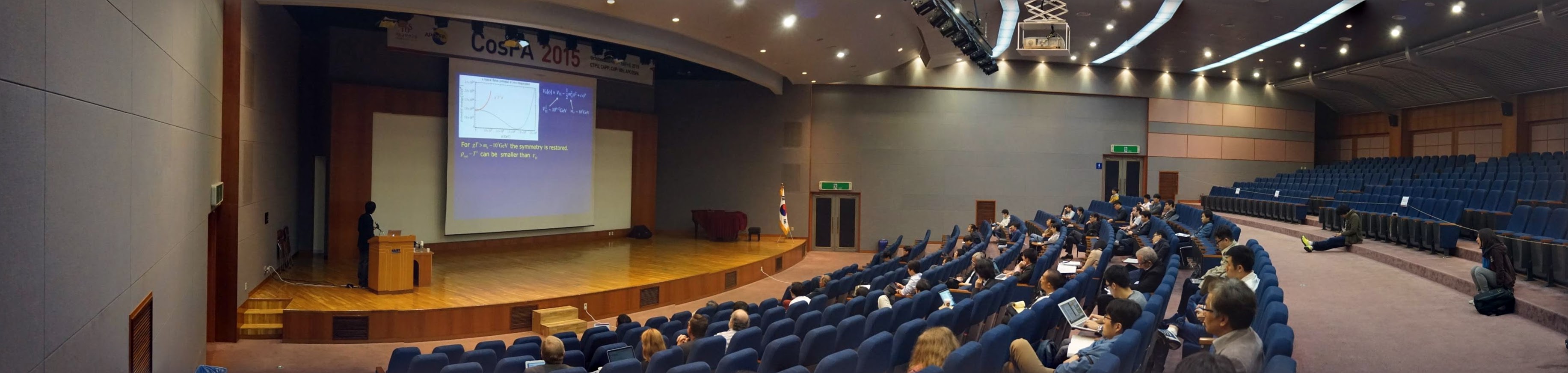
CosPA 2015
12-16 October 2015
Lecture Building, KAIST Munji Campus, Daejeon, Korea

12th Conference in the Symposium on Cosmology and Particle Astrophysics series 12-16 October 2015, Daejeon, Korea.
CosPA 2015 is the 12th International Symposium on Cosmology and Particle Astrophysics. It will be held from the 12-16 October 2015 at the Center for Theoretical Physics of the Universe (CTPU) of Institute for Basic Science (IBS), located at the KAIST Munji Campus in Daejeon City.
CosPA 2015 conference will bring together theorists, experimentalists and observers working in the field of cosmology, astrophysics and particle physics to discuss the latest results and ideas and the prospects for progress.
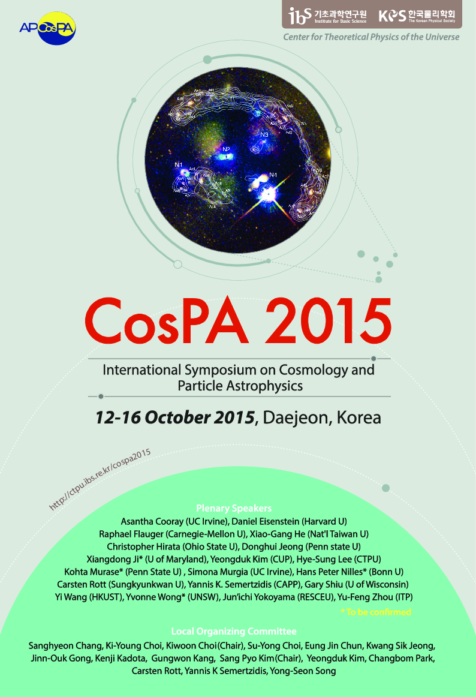
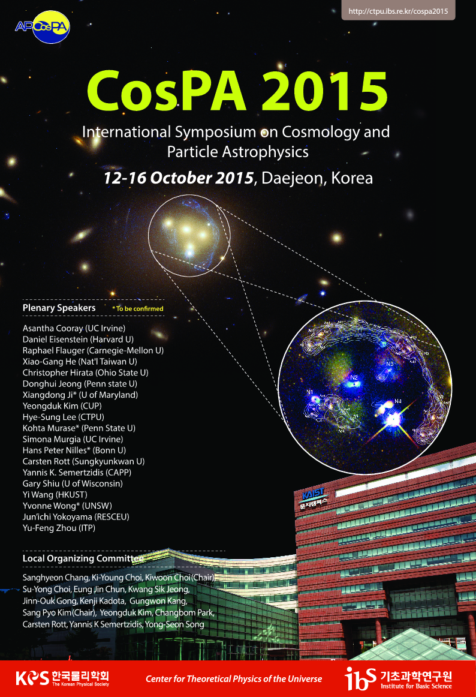
Photos from ESA and arXiv:1504.03388
-
-
Registration Supex Hall
Supex Hall
Lecture Building, KAIST Munji Campus, Daejeon, Korea
KAIST Munji Campus. 193, Munji-ro, Yuseong-gu, Daejeon, koreaRegistration for the workshop and social event
-
1
Opening Supex Hall
Supex Hall
Lecture Building, KAIST Munji Campus, Daejeon, Korea
KAIST Munji Campus. 193, Munji-ro, Yuseong-gu, Daejeon, koreaOpening Remark by IBS president Dr. Doochul Kim and APCosPA director Dr. Pauchy W-Y. HwangSpeakers: Dr Doochul Kim (IBS), Dr Pauchy W-Y. Hwang (APCosPA) -
Plenary Session Supex Hall
Supex Hall
Lecture Building, KAIST Munji Campus, Daejeon, Korea
KAIST Munji Campus. 193, Munji-ro, Yuseong-gu, Daejeon, koreaConveners: Dr Gungwon Kang (Chair), Dr Sang Pyo Kim (Chair)-
2
Status of Neutrino AstronomyThe latest results from neutrino telescopes will be reviewed. The observation of high-energy astro-physical neutrinos by IceCube will be discussed and potential sources candidates evaluated. The talk will conclude with an overview of the discovery potential at the next generation of neutrino telescopes.Speaker: Dr Carsten Rott (Sungkyunkwan U.)
-
3
Baryon Acoustic Oscillations: A Robust and Precise Route to the Cosmological Distance ScaleThe baryon acoustic oscillations now provide one of our most robust methods for measuring the cosmic distance scale. I will review the physical principles of the method and describe some recent developments in the practical methodology. I will then present recent BAO results and cosmological implications from the Baryon Oscillation Spectroscopic Survey, part of Sloan Digital Sky Survey III. I will close with a discussion of plans for the next generation of wide-field spectroscopic surveys.Speaker: Dr Daniel Eisenstein (Harvard U.)
-
10:45
Break
-
4
Status of CMB observations: Planck and beyondI will review the current status of CMB observations focusing on the ESA Planck mission. I will also review the status of B modes searches, reviewing the current limits and the many experiments coming online or in the planning stage that promise either to make a first discovery or to substantially tighten current upper bounds.Speaker: Dr Martin Bucher (APC/U. of Paris)
- 5
-
2
-
12:45
Lunch Cafeteria
Cafeteria
-
Parallel 1: A1 103
103
Lecture Building, KAIST Munji Campus, Daejeon, Korea
KAIST Munji Campus. 193, Munji-ro, Yuseong-gu, Daejeon, koreaConveners: Jinn-Ouk Gong (Convener), Sekiguchi Toyokazu (Chair)- 6
- 7
- 8
- 9
-
parallel 2: C1 104
104
Lecture Building, KAIST Munji Campus, Daejeon, Korea
KAIST Munji Campus. 193, Munji-ro, Yuseong-gu, Daejeon, koreaConveners: Carsten Rott (Chair), Kenji Kadota (Convener)- 10
- 11
- 12
- 13
-
15:40
Break
-
Parallel 1: B1 103
103
Lecture Building, KAIST Munji Campus, Daejeon, Korea
KAIST Munji Campus. 193, Munji-ro, Yuseong-gu, Daejeon, koreaConveners: Seokcheon Lee (Chair), Yong-Seon Song (Convener)- 14
- 15
- 16
-
parallel 2: C2 104
104
Lecture Building, KAIST Munji Campus, Daejeon, Korea
KAIST Munji Campus. 193, Munji-ro, Yuseong-gu, Daejeon, koreaConveners: Kenji Kadota (Convener), Ki-Young Choi (Chair)- 17
- 18
- 19
-
-
-
Plenary Session Supex Hall
Supex Hall
Lecture Building, KAIST Munji Campus, Daejeon, Korea
KAIST Munji Campus. 193, Munji-ro, Yuseong-gu, Daejeon, koreaConvener: Yong-Seon Song (Chair)- 20
-
21
Searching for dark matter with gamma raysEvidence for dark matter is overwhelming. From experimental data we can infer that dark matter constitutes most of the matter in the Universe and that it interacts very weakly, and at least gravitationally, with ordinary matter. However we do not know what it is. Several theoretical models have been proposed that predict the existence of Weakly Interacting Massive Particles (WIMPs) that are excellent dark matter candidates. The existence of WIMPs can be tested indirectly, primarily through their annihilation or decay into photons. In this talk I'll present the latest results on these searches.Speaker: Dr Simona Murgia (U.C. Irvine)
-
10:30
Break
- 22
-
23
Cosmology with the HETDEX surveyHETDEX (Hobby-Eberly Telescope Dark Energy eXperiment) is a galaxy survey targeting Lyman-alpha emitters (LAEs) at high redshifts (1.9 < z < 3.5). Starting from late 2015, the survey will observe about a million LAEs over ~400 sq. degrees, which corresponds to ~10Gpc3 in volume. The main science goal of HETDEX is to measure the angular diameter distance and the Hubble expansion rate at high redshifts (z~2.5 and z~3) within a percent accuracy, so that we can measure the dark energy density better than 3-σ. In this talk, I will introduce the HETDEX survey, summarize the survey design, observing strategy, as well as various cosmological information that the dataset can provide.Speaker: Dr Donghui Jeong (Penn State U.)
-
12:45
Lunch Cafeteria
Cafeteria
-
Parallel 1: B2 103
103
Lecture Building, KAIST Munji Campus, Daejeon, Korea
KAIST Munji Campus. 193, Munji-ro, Yuseong-gu, Daejeon, koreaConveners: Daniel Eisentstein (Chair), Yong-Seon Song (Convener)- 24
- 25
- 26
- 27
-
parallel 2: C3 104
104
Lecture Building, KAIST Munji Campus, Daejeon, Korea
KAIST Munji Campus. 193, Munji-ro, Yuseong-gu, Daejeon, koreaConveners: Kenji Kadota (Convener), Simona Murgia (Chair)- 28
- 29
- 30
- 31
-
15:40
Break
-
Parallel 1: B3 103
103
Lecture Building, KAIST Munji Campus, Daejeon, Korea
KAIST Munji Campus. 193, Munji-ro, Yuseong-gu, Daejeon, koreaConveners: Asantha Cooray (Chair), Yong-Seon Song (Convener)- 32
- 33
- 34
- 35
-
parallel 2: D1 104
104
Lecture Building, KAIST Munji Campus, Daejeon, Korea
KAIST Munji Campus. 193, Munji-ro, Yuseong-gu, Daejeon, koreaConveners: Ki-Young Choi (Convener), Yvonne Wong (Chair)- 36
- 37
- 38
- 39
-
18:05
Banquet Main Hall
Main Hall
Lecture Building, KAIST Munji Campus, Daejeon, Korea
KAIST Munji Campus. 193, Munji-ro, Yuseong-gu, Daejeon, korea
-
-
-
IBS Session Supex Hall
Supex Hall
Lecture Building, KAIST Munji Campus, Daejeon, Korea
KAIST Munji Campus. 193, Munji-ro, Yuseong-gu, Daejeon, koreaConvener: Kiwoon Choi (Chair)- 40
-
41
Scientific Programs of CUPThe Center for Underground Physics (CUP) aims to pursue searches for new particles and new phenomena beyond the standard model. We are trying to push the experimental limits for the neutrinoless double beta decays (AMoRE) and the direct detection of the WIMPs (KIMS+). We are also working on the reactor neutrino experiment to search for the sterile neutrinos (NEOS). I will describe the scientific significance and the status of these programs.Speaker: Dr Yeongduk Kim (CUP/IBS)
-
42
Axions, axion dark-matter, and high precision electric dipole moment experiments at CAPPWe have just reached the two year anniversary of the establishment of the IBS center for Axion and Precision Physics at the KAIST campus in Korea. Our plan is to establish axion dark matter experiments that will have the sensitivity to answer whether axions are part of the dark matter in our galaxy. We are making advances in high Tc magnet technology, efficient resonator geometries, low noise microwave amplifiers, and in understanding of superconductivity-magnetic field interactions. If successful, we should be able to observe axions even if they are only 10% of the dark matter for a major part of the allowed axion mass in the microwave region. Developments in the storage ring electric dipole moment experiments should increase our sensitivity to θQCD and New Physics by several orders of magnitude.Speaker: Dr Yannis K. Semertizidis (CAPP/IBS)
-
10:35
Coffee Break
-
43
Physics of Dark Gauge InteractionDark gauge interaction typically refers to an interaction mediated by a gauge boson with a very light mass (typically MeV - GeV scale) and a very small coupling to the Standard Model particles. I will overview some of the dark gauge interaction physics based on my own works in this field.Speaker: Dr Hye-Sung Lee (CTPU/IBS)
-
APCosPA Council and General Assembly
-
12:00
Excursion Gongju
Gongju
Excursion to Gongju, ancient city near by Daejeon
-
-
-
Plenary Session Supex Hall
Supex Hall
Lecture Building, KAIST Munji Campus, Daejeon, Korea
KAIST Munji Campus. 193, Munji-ro, Yuseong-gu, Daejeon, koreaConvener: Tim Tait (Chair)-
45
Theory for Neutrino MixingTremendous progresses on neutrino mixing have been made both experimentally and theoretically. Recent data show that the mixing angles in the PMNS are not always small as their quark mixing counter part. In the standard parametrization for three neutrino mixing commonly used, the mixing angle θ23 is close to π/4, θ12 is also large, θ13 is relatively small but away from zero. There are also evidences show that the CP violating Dirac phase delta is close to -π/2 (or 3π/2). In this after some brief review on theoretical ideas about neutrino mixing, I discuss how to understand the mixing pattern and to construct theoretical models to accommodate current data.Speaker: Dr Xiao-Gang He (Shanghai Jiao Tong Univ./National Taiwan Univ.)
-
46
Towards gauge theory for EW scale DMI present gauge models for EW scale DM, and discuss the role of DM, dark gauge bosons and dark Higgs in this class of models in the context of particle physics, DM phenomenology and cosmology, including Higgs signal strength, collider searches of DM, galactic center gamma ray excess, dark radiation and Higgs inflation.Speaker: Dr Pyungwon Ko (KIAS)
-
10:30
Break
-
47
Axions: Diversity beats SimplicityWhile axions have been initially proposed as a solution of the strong CP-problem, they might also find useful applications in cosmology: as candidates for cold dark matter, dark energy (quintessence) and inflation. The ultraviolet completion within the framework of string theory provides a plethora of axions and motivates the consideration of mult-axion systems as a solution to some of the remaining problems in explicit model building.Speaker: Dr Hans Peter Nilles (Bonn U.)
-
48
Inflation in String TheorySpeaker: Dr Gary Shiu (U. of Wisconsin)
-
45
-
12:45
Lunch Cafeteria
Cafeteria
-
Parallel 1: A2 103
103
Lecture Building, KAIST Munji Campus, Daejeon, Korea
KAIST Munji Campus. 193, Munji-ro, Yuseong-gu, Daejeon, koreaConveners: Hyun Min Lee (Chair), Jinn-Ouk Gong (Convener)- 49
- 50
- 51
- 52
-
parallel 2: D2:LHC Special Session 104
104
Lecture Building, KAIST Munji Campus, Daejeon, Korea
KAIST Munji Campus. 193, Munji-ro, Yuseong-gu, Daejeon, koreaConveners: Ki-Young Choi (Convener), Pyungwon Ko (Chair)- 53
- 54
- 55
-
15:25
Break
-
15:40
Break
-
parallel 2: D3 104
104
Lecture Building, KAIST Munji Campus, Daejeon, Korea
KAIST Munji Campus. 193, Munji-ro, Yuseong-gu, Daejeon, koreaConveners: Ki-Young Choi (Convener), Xiao Gang He (Chair)- 56
- 57
- 58
- 59
- 60
-
Parallel 1: A3 103
103
Lecture Building, KAIST Munji Campus, Daejeon, Korea
KAIST Munji Campus. 193, Munji-ro, Yuseong-gu, Daejeon, koreaConvener: Jinn-Ouk Gong (Chair, Convener)- 61
- 62
- 63
- 64
-
-
-
Plenary Session Supex Hall
Supex Hall
Lecture Building, KAIST Munji Campus, Daejeon, Korea
KAIST Munji Campus. 193, Munji-ro, Yuseong-gu, Daejeon, koreaConvener: Sang Pyo Kim (Chair)- 65
-
66
Quantum Primordial Standard ClocksIn this paper, we point out and study a generic type of signals existing in the primordial universe models, which can be used to model-independently distinguish the inflation scenario from alternatives. These signals are generated by massive fields that function as standard clocks. The role of massive fields as standard clocks has been realized in previous works. Although the existence of such massive fields is generic, the previous realizations require sharp features to classically excite the oscillations of the massive clock fields. Here, we point out that the quantum fluctuations of massive fields can actually serve the same purpose as the standard clocks. We show that they are also able to directly record the defining property of the scenario type, namely, the scale factor of the primordial universe as a function of time a(t), but through shape-dependent oscillatory features in non-Gaussianities. Since quantum fluctuating massive fields exist in any realistic primordial universe models, these quantum primordial standard clock signals are present in any inflation models, and should exist quite generally in alternative-to-inflation scenarios as well. However, the amplitude of such signals is very model-dependent.Speaker: Dr Yi Wang (HKUST)
-
10:30
Break
-
67
Gravitational waves from the early UniverseThe gravitational wave is a useful probe of the early Universe which directly carries information of the epochs all the way up to the inflationary era. There are a number of production mechanisms of gravitational waves in the early Universe such as: (i) quantum tensor perturbation generated during inflation, (ii) gravitational waves generated by second-order perturbation of density fluctuations, (iii) those generated by bubble collision after first-order phase transitions, (iv) those created by self-ordering of multi-component scalar fields after a global symmetry breaking, and (v) gravitational from topological defects, especially from oscillating cosmic strings. I will talk about some of the above production mechanisms and discuss their implications to cosmology of the early Universe, in particular, the possibility to determine thermal history using the power spectrum of gravitational waves.Speaker: Dr Jun'ichi Yokoyama (RESCEU)
-
Closing Remark Supex Hall
Supex Hall
Lecture Building, KAIST Munji Campus, Daejeon, Korea
KAIST Munji Campus. 193, Munji-ro, Yuseong-gu, Daejeon, korea
-