PASCOS 2021
ZOOM (Online)
IBS
PASCOS 2021
Center for Theoretical Physics of the Universe, Institute for Basic Science,
Daejeon, Korea, June 14-18, 2021.
https://indico.ibs.re.kr/e/pascos2021
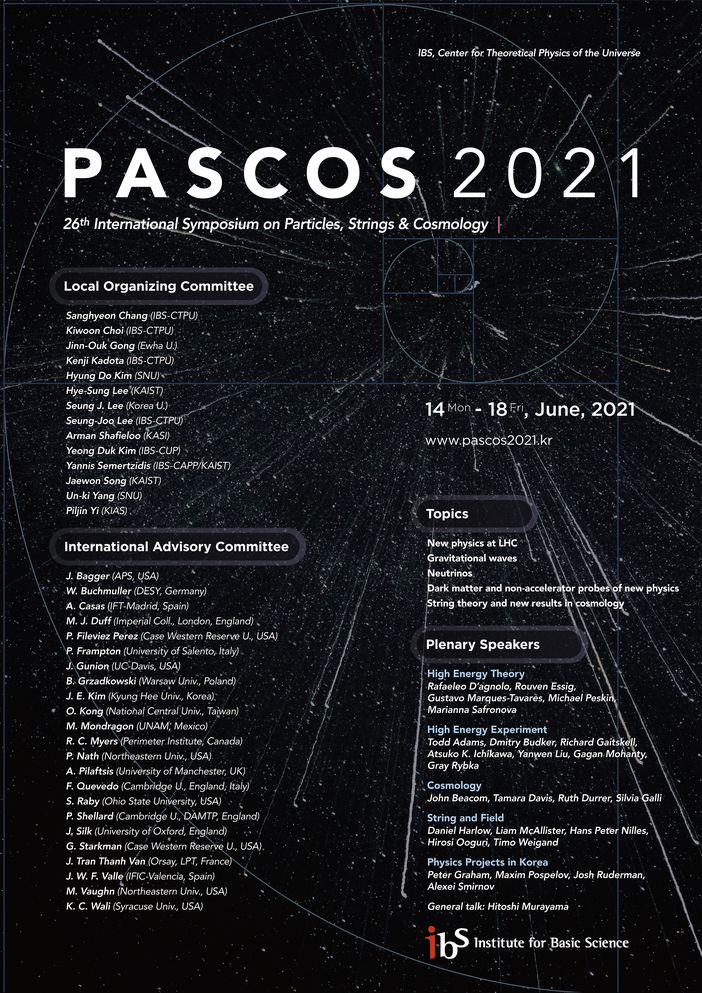
PASCOS 2021 the 26th International Symposium on Particle Physics, String Theory, and Cosmology, will take place on June 14-18, 2021. The aim of the conference is to review recent progress in particle physics, astroparticle physics, string theory and cosmology, with particular emphasis on their interconnections. The symposium is a platform for researchers to report and discuss what has been learnt and what might show up in the next few years. Topics will include new physics at LHC, gravitational waves, neutrinos, dark matter and non-accelerator probes of new physics, string theory and new results in cosmology.
The conference includes invited plenary talks as well as contributed talks. We particularly welcome and encourage the participation of early career researchers.
PASCOS 2021 will be hosted via ZOOM by the Institute for Basic Science, Center for Theoretical Physics of the Universe, Daejeon, Republic of Korea
Important deadlines (in KST)
May 5: presentation registration
June 7: general registration
Venue
IBS (Online): Zoom link will be sent to the registered participants. It will be broadcasted through Youtube too. At youtube.com, search for 'PASCOS 2021'.
Sponsored by

-
-
08:20
→
10:20
Plenary 1Convener: Yannis K. Semertizidis (IBS CAPP/KAIST)
-
08:20
A Vision for Neutrino Astronomy 40mFrom successes over the past decades, we know that neutrino astronomy is both possible and powerful. But now what? I review the frontiers of this field and present a vision for its future. Success will have wide implications for both physics and astronomy.Speaker: John Beacom (Ohio State U.)
-
09:00
Cosmological constraints on fundamental physics 40mIn this talk I will give an overview of cosmological constraints on fundamental physics. There are now such a wide variety of cosmological probes — including supernovae, gravitational waves, large scale structure, peculiar velocities, gravitational lensing, the cosmic microwave background, and more — that any new theory is constrained on many sides. At the same time some small tensions are arising between different cosmological probes, indicating new physics may be needed. It’s an exciting time! We will discuss both some of the latest results, and also the important search for systematics in the data, which is needed before we draw conclusions about the need for new physics.Speaker: Tamara Davis (U. of Queensland)
-
09:40
Charged particles for dark matter detection 40mI will discuss two new ideas for using charged particles for dark matter detection. First, we find that ion traps allow sensitive searches for millicharged dark matter. Motivated by both particle physics and quantum information, significant experimental work has gone into isolating the ions from the environment. Millicharged dark matter would provide an irreducible source of heating for a trapped ion with a characteristic spectrum of events. We find that results from existing ion traps already place limits on millicharged particle parameter space far beyond previous constraints. Future ion trap experiments could significantly improve this reach with prospects for discovering millicharged dark matter over many orders of magnitude in mass and charge. Second, we will discuss the use of charged particle storage rings for detection of axion dark matter and dark energy. The relativistic speed of the particles in the ring significantly boosts the signal. This allows a sensitive search for axions and dark photons in the lightest possible dark matter mass range.Speaker: Peter Graham (Stanford U./ITP)
-
08:20
-
10:20
→
10:50
Break 30m
-
10:50
→
12:10
Parallel 1A: CosmologyConvener: Takahiro Terada (IBS-CTPU)
- 10:50
- 11:10
- 11:30
- 11:50
-
10:50
→
12:10
Parallel 1B: String and FieldConvener: Seok Kim (SNU)
- 10:50
- 11:10
- 11:30
- 11:50
-
12:10
→
13:30
Lunch 1h 20m
-
13:30
→
15:00
Special SessionConvener: SungWoo Youn (IBS)
-
13:30
Dark matter search in the COSINE-100 experiment 30mAlthough there is evidence for the existence of dark matter in astrophysical observations, no direct detection has been reported except for claims of the DAMA/LIBRA collaboration. COSINE-100 experiment has been operating since September 2016 aiming to reproduce the DAMA/LIBRA annual modulation signal. The target material is NaI(Tl) crystal, as in the DAMA/LIBRA experiment. Data is being taken at the 700-m-deep Yangyang underground laboratory, Korea. In addition to the analysis of the annual modulation signal, interpretations based on various models have also been performed. With the recent successful lowering of the energy threshold from 2 keV to 1 keV, a new analysis is ongoing and near completion. In this presentation, we present an introduction of the experiment and the latest analysis results, as well as show the plans for the next phase, after validation of the DAMA/LIBRA's result.Speaker: Young Ju KO (IBS CUP)
-
14:00
Axion Dark Matter Search at IBS/CAPP in Korea 30mIt is extremely challenging to build an axion dark matter search experiment that could explore the wide range of plausible masses with enough sensitivity. However, thanks to recent technological advances in superconducting material research, physicists are now embarking on the most sensitive search yet for axons. For the last seven years, IBS/CAPP has established the state-of-the-art axion detector facility in Korea with six dilution refrigerators, of which three axion detectors are running and taking data in parallel now. The powerful 12 T big-bore (32 cm) Nb3Sn superconducting magnet has been added to the line-up and ready to take physics data this summer. CAPP is now standing at the critical time moving forward with improvements from R&Ds, raising the axion-to-photon conversion power, lowering the system noise and eventually increasing the scanning speed to cover more mass ranges in less time. The critical R&Ds include the development of quantum noise limited amplifiers in collaboration with the Nakamura group at the U. of Tokyo and the superconducting ReBCO cavity that sustains high Q-factor even at 8 T. We are now preparing an axion data run with quantum amplifiers and a superconducting cavity within this year. I will present the status of CAPP’s axion search and R&D efforts, including future plans.Speaker: Woohyun CHUNG (IBS CAPP)
-
14:30
The first result from the Muon g-2 experiment at Fermilab 30mThe result of first run (Run-1) of the Muon g-2 experiment at Fermilab has been officially announced on April 7th, drawing a lot of attention of the particle physics communities around the world with its exciting result confirming the previous measurement performed in Brookhaven National Laboratory nearly 20 years ago. The new experimental average of the magnetic anomaly of the muon has a discrepancy of 4.2 standard deviation with the Standard Model expectation. We present from the brief experimental overview and the measurement principle of the Muon g-2 experiment at Fermilab to the detailed Run-1 analysis method and result, followed by the current status and prospects of the experiment.Speaker: On Kim (IBS CAPP)
-
13:30
-
15:00
→
15:30
Break 30m
-
15:30
→
16:50
Parallel 2A: String and FieldConvener: Pablo Soler (IBS-CTPU)
- 15:30
- 15:50
- 16:10
- 16:30
-
15:30
→
16:50
Parallel 2B: CosmologyConvener: Chang Sub Shin (IBS-CTPU)
- 15:30
- 15:50
- 16:10
- 16:30
-
16:50
→
17:20
Break 30m
-
17:20
→
18:40
Plenary 2Convener: Intae Yu (SKKU)
-
17:20
Neutrino Oscillations – current status and prospects – 40mSince the discovery of neutrino oscillation in 1998, an overall picture of the flavor-mass mixing in the lepton sector has been build. Compared to those in the quark sector, the mixing angles are large and squared masses are much smaller. Missing in the picture is the CP phase and the ordering of masses. With the large mixing angles, the size of the CP violation, Jarlskog invariant, in the lepton sector can be three orders of magnitude larger than that in the quark sector. Large CP violation in the lepton sector may be a source of the present matter-antimatter asymmetry in our universe. In this talk, I will present the latest status and prospect of the neutrino oscillation measurements. In particular, searches for CP violation by accelerator long baseline experiments will be discussed in detail.Speaker: Atsuko Ichikawa (Kyoto U.)
-
18:00
Recent developments in physics of neutrino oscillations 40mRecent results in physics of neutrino oscillations will be reviewed. Those include various aspects of coherence and refraction, in particular, the resonance refraction, effects of sterile neutrinos, non-standard interactions, scattering on dark matter. The role of reactor neutrino experiments in these developments will be outlined.Speaker: Alexei Smirnov (Max-Planck-Institute)
-
17:20
-
08:20
→
10:20
-
-
08:20
→
10:20
Plenary 3Convener: Jaewon Song (KAIST)
-
08:20
Stringy Resolutions of Null Singularities 40mI will discuss two types of singularities in amplitudes caused by null geodesics in anti-de Sitter spacetime and their resolutions by stringy effects. Certain Landau singularities are resolved by the Gross-Mende effect, and null singularities near the black hole photon sphere are resolved by stringy tidal effects. Interpretations of these singularities and their resolutions in the context of the AdS/CFT correspondence and their generalization to asymptotically flat spacetime will also be discussed.Speaker: Hirosi Ooguri (Caltech/IPMU)
-
09:00
String Vacua and Axions 40mI will report on progress in computing four-dimensional effective theories of quantum gravity from compactifications of string theory. I will describe applications to axion cosmology, the strong CP problem, and black hole superradiance, emphasizing novel aspects that arise when the number of moduli is large.Speaker: Liam McAllister (Cornell U.)
- 09:40
-
08:20
-
10:20
→
10:50
Break 30m
-
10:50
→
12:30
Parallel 3A: Particle PhysicsConvener: Thomas Flacke (IBS CTPU)
- 10:50
- 11:10
- 11:30
- 11:50
- 12:10
-
10:50
→
12:30
Parallel 3B: CosmologyConvener: Jiajun Zhang (IBS-CTPU)
- 10:50
- 11:10
- 11:30
- 11:50
- 12:10
-
12:30
→
13:40
Lunch 1h 10m
-
13:40
→
15:00
Parallel 4A: String and FieldConvener: Sangmin Lee (SNU)
- 13:40
- 14:00
- 14:20
- 14:40
-
13:40
→
15:00
Parallel 4B: Particle PhysicsConvener: Seongchan Park (Yonsei U.)
- 13:40
- 14:00
- 14:20
- 14:40
-
15:00
→
15:30
Break 30m
-
15:30
→
16:50
Parallel 5A: Particle PhysicsConvener: Kang Young Lee (GNU)
- 15:30
- 15:50
- 16:10
- 16:30
-
15:30
→
16:50
Parallel 5B: CosmologyConvener: Ki-Young Choi (SKKU)
- 15:30
- 15:50
- 16:10
- 16:30
-
16:50
→
17:20
Break 30m
-
17:20
→
18:40
Plenary 4Convener: Arman Shafieloo (KASI)
- 17:20
-
18:00
Testing General Relativity with Cosmological observations 40mGeneral Relativity (GR) is immensely successful. With the late discovery of gravitational waves from black hole and neutron star mergers, it has passed all the tests with flying colors. But so far, all observations have mainly tested the vacuum equations of GR. The most important non-vacuum case, cosmology, is in agreement with GR only after the introduction of two otherwise unknown components, 'Dark Matter' and 'Dark Energy' which amount to about 96% of the total energy budget of the present Universe. This lets us question the validity of GR for cosmology. Might it be that GR is flawed on large, cosmological scales? Or in the presence of matter in general? But how can we test Einstein's equation in the presence of matter. Can't we simply move any modification of the Einstein tensor to the right hand side and call it a 'dark matter/dark energy' component? In my talk I shall discuss possible ways (partially) out of this dilemma. How to test both, the left and the right hand side of Einstein's equations with cosmological observations.Speaker: Ruth Durrer (U. of Geneva)
-
08:20
→
10:20
-
-
08:20
→
10:20
Plenary 5Convener: Hyun Min Lee (Chung-Ang U.)
-
08:20
Axion Dark Matter Searches 40mThe QCD axion is one of the leading particle candidates to explain what makes up the dark matter of the universe. In the last decade, advances in detectors has enabled the construction of experiments that are sensitive to the most plausible axion dark matter models. Now the race is on to search the theoretically favored masses and couplings and make a discovery. I will highlight efforts world-wide to find the axion and discuss recent results from the Axion Dark Matter Experiment, the most sensitive experiment presently operating.Speaker: Gray Rybka (U. of Washington)
-
09:00
Neutron portal: recent developments 40mMixing of neutrons (or more generically three-quark states ) with dark fermions may generate interesting phenomenological consequences such as novel decay channels for neutrons, a possibility of neutron oscillation to dark states etc. I review certain laboratory constraints, as well as cosmological and astrophysical probes that significantly narrow down the available parameter space. I will review, in some detail, the pulsar heating phenomenon that provides tight constraint on neutron-mirror neutron oscillations.Speaker: Maxim Pospelov (U. of MInnesota/FTPI)
-
09:40
Dark Matter Direct Detection: Signal or no signal? The best way(s) forward. 40mParticle dark matter is thought to be the overwhelming majority of the matter in the Universe. Its gravitational contribution overwhelms that from the ordinary matter that we, the earth and the stars, are composed of. However, providing direct evidence for the existence of particle dark matter has proved extremely challenging and any positive results remain controversial. We have been searching for the direct interactions of dark matter in sub-terrestrial detectors for over 35 years. A wide-range of techniques have been employed in order to establish convincing evidence for these interactions. I have worked on five of them during this period. In the early-experimental stages of our searches interaction rates in detectors of 100 per kg per day were explored. Today we are looking for dark matter events which are as rare as 1 per kg per millennium. We now carry this out with detectors that have active masses that are as large as 10 tonnes, but yet they can be sensitive to particle interactions with energies of less than 1 keV. The detectors exploit a wide range of detection techniques including the scintillation or ionization properties of noble elements, bubbles in superheated fluids, ionization in semiconductors, and phonons in milliKelvin targets. Often these technologies are combined together. I will discuss some of the latest results in the field of direct detection, and look at the best techniques that may help us to definitively detect the illusive dark matter particles.Speaker: Richard Gaitskell (Brown U.)
-
08:20
-
10:20
→
10:50
Break 30m
-
10:50
→
12:30
Parallel 6A: Particle PhysicsConvener: Chang-Seong Moon (KNU)
- 10:50
- 11:10
- 11:30
- 11:50
- 12:10
-
10:50
→
12:30
Parallel 6B: CosmologyConvener: Hang Bae Kim (Hanyang U.)
- 10:50
- 11:10
- 11:30
- 11:50
- 12:10
-
12:30
→
13:40
Lunch 1h 10m
-
13:40
→
15:00
Parallel 7A: CosmologyConvener: Cristiano Sabiu (U. of Seoul)
- 13:40
- 14:00
- 14:20
- 14:40
-
13:40
→
15:00
Parallel 7B: String and FieldConvener: Sung-Soo Kim (UESTC)
- 13:40
- 14:00
- 14:20
- 14:40
-
15:00
→
15:30
Break 30m
-
15:30
→
16:50
Parallel 8A: Particle PhysicsConvener: Sin Kyu Kang (SeoulTech)
- 15:30
- 15:50
- 16:10
- 16:30
-
15:30
→
16:50
Parallel 8B: String and FieldConvener: Keun-Young Kim (GIST)
- 15:30
- 15:50
- 16:10
- 16:30
-
16:50
→
17:20
Break 30m
-
17:20
→
18:40
Plenary 6Convener: Hyung Do Kim (SNU)
-
17:20
Cosmological Naturalness 40mThe cosmological constant problem is the most spectacular failure of dimensional analysis in physics. The most credible explanation so far, requires the existence of a vast landscape of cosmological constant values, including exponentially tuned ones. If we accept the existence of a landscape, it is very likely that also the Higgs boson mass squared varies from vacuum to vacuum. Historically this point of view coincides with anthropic explanations for its observed value. More recently we have developed a class of ideas that makes a different use of a Higgs mass landscape, with much better prospects for detection and little or no recourse to anthropic arguments. After the results from LEP, LHC, Flavor and CP violation experiments, accumulated over more than 40 years, these ideas have become one of the most appealing possibilities to explain the observed value of the Higgs mass. In the talk I will first briefly discuss the role of naturalness in quantum field theory, then review these ideas, including their generic predictions for experiment and prospects for discovery.Speaker: Raffaele D’agnolo (IPhT/Saclay)
-
18:00
Depleting or Producing Dark Matter 40mNew ideas about the origin of dark matter are being driven by experimental progress. Increasingly powerful constraints from direct and indirect detection are leading to the exploration of new masses and interactions for dark matter. I will describe recent developments identifying novel mechanisms for the production of nonthermal dark matter or the depletion of thermal dark matter.Speaker: Joshua Ruderman (New York U./CCPP)
-
17:20
-
08:20
→
10:20
-
-
08:20
→
10:20
Plenary 7Convener: Hye-Sung Lee (KAIST)
-
08:20
Quantum Technologies for New-physics Discoveries 40mThe extraordinary advances in quantum control of matter and light have been transformative for precision measurements enabling probes of the most basic laws of Nature to gain a fundamental understanding of the physical Universe. Exceptional versatility, inventiveness, and rapid development of precision experiments supported by continuous technological advances and improved atomic and molecular theory led to rapid development of many avenues to explore new physics. I will give an overview of atomic and molecular physics searches for physics beyond the standard model and then focus on dark matter searches with atomic and nuclear clocks.Speaker: Marianna Safronova (U. of Delaware)
- 09:00
-
09:40
Dark sector visible signals in neutron star mergers 40mIn this talk I will present new ways to detect dark sectors through transient visible signals following a neutron star merger. Focusing on the dark photon scenario, I will show that the merger remnant can produce a very large flux of dark photons, and explore the visible signatures coming from their decays. The most promising signal is a bright and short burst of MeV photons produced by the decay products. This can be used to probe a large portion of unexplored parameter space, including much of the unconstrained parameter space for freeze-in dark matter models with interactions mediated by the dark photon.Speaker: Gustavo Marques-Tavares (U. of Maryland)
-
08:20
-
10:20
→
10:50
Break 30m
-
10:50
→
12:10
Parallel 9A: String and FieldConvener: Sungjay Lee (KIAS)
- 10:50
- 11:10
- 11:30
- 11:50
-
10:50
→
12:30
Parallel 9B: CosmologyConvener: Kenji Kadota (IBS-CTPU)
- 10:50
- 11:10
- 11:30
- 11:50
- 12:10
-
12:30
→
13:40
Lunch 1h 10m
-
13:40
→
15:00
Parallel 10A: CosmologyConvener: Sungwook Hong (KASI)
- 13:40
- 14:00
- 14:20
- 14:40
-
13:40
→
15:00
Parallel 10B: Particle PhysicsConvener: Jong-Chul Park (CNU)
- 13:40
- 14:00
- 14:20
- 14:40
-
15:00
→
15:30
Break 30m
-
15:30
→
16:50
Parallel 11A: CosmologyConvener: Jinn-Ouk Gong (Ewha U.)
- 15:30
- 15:50
- 16:10
- 16:30
-
15:30
→
16:50
Parallel 11B: Particle PhysicsConvener: Myeonghun Park (SeoulTech)
- 15:30
- 15:50
- 16:10
- 16:30
-
16:50
→
17:20
Break 30m
-
17:20
→
18:40
Plenary 8Convener: Youngjoon Kwon (Yonsei U.)
- 17:20
-
18:00
Latest results from Belle and Belle II 40mIn this invited plenary talk, we report recent results based on the e+e- collision data recorded by the Belle II experiment and the legacy data from its predecessor (Belle), both at the KEK laboratory of Japan. These would include the study of CP violation in B and D meson decays, search for suppressed decays of B and D mesons and tau leptons, as well as probe for dark matter candidates.Speaker: Gagan Mohanty (Tata Institue)
-
18:40
→
19:00
Break 20m
-
19:00
→
20:00
Public Talk: Quantum Universe
Where do we come from? Science is making progress on this age-old question of humankind. The Universe was once microscopic, much smaller than the size of an atom. Small things mattered in the small Universe, where quantum physics dominated the scene. To understand the way the Universe is today, we have to solve remaining major puzzles. The mysterious dark matter is our mother, we would not have been born without it, and is holding the galaxy together. But nobody has seen it directly. The neutrinos may be superheroes that saved us from complete annihilation. How will we know? And the Universe was stretched from microscopic to macroscopic size by inflation, who is our father that planted the seeds for stars and galaxies we see today. But do we ever meet him? I will discuss exciting future in this research.
Convener: Prof. Hitoshi Murayama
-
08:20
→
10:20
-
-
08:20
→
10:20
Plenary 9Convener: Un-ki Yang (SNU)
-
08:20
Searches for BSM Physics at the LHC 40mThe Large Hadron Collider (LHC) is the world’s highest energy accelerator and LHC Run 2 provides a spectacular dataset to search for evidence of physics beyond the Standard Model (BSM). The energy allows for the production of high mass particles that could not be produced anywhere else while the large Run 2 dataset is exploring rare processes. Results from searches from the ATLAS, CMS, and LHC-b experiments will be presented including supersymmetry, dark matter, heavy neutral leptons, and long-lived particles. Results from tests of lepton universality will be included. The future of searches at the LHC will also be discussed.Speaker: Todd Adams (Florida State U.)
-
09:00
Latest LHC results on the Higgs Boson and Multi-Boson 40mThe LHC is currently the unique place to measure directly the properties of the Higgs boson, the only scalar particle in the Standard Model that breaks the electroweak gauge symmetry and attributes masses to all elementary particle. The interactions of the massive electroweak gauge bosons are profoundly related to the Higgs boson. In this talk, recent progresses from the ATLAS and CMS experiments on the measurements of Higgs boson properties, multi-Boson productions will be presented. These measurements test the Standard Model with unprecedented precisions and probe new physics beyond the Standard Model.Speaker: Yanwen Liu (USTC)
-
09:40
Precision Higgs Physics at Future e+e- Colliders 40mThe next goal for high-energy accelerator experiments is the precision study of the Higgs boson. This can be accomplished by an electron-positron collider covering the energy region 250 GeV - 1 TeV. There is now an opportunity to construct an accelerator of this type, an e+e- Higgs Factory. In this talk, I will review (1) why the study of the Higgs boson is so important, and how it can open a new window on physics beyond the Standard Model, (2) why e+e- colliders give important advantages for the study of the Higgs boson, (3) how Higgs boson measurements fit into a more general program of Standard Model precision tests, and how this viewpoint enhances the power of the Higgs boson measurements, (4) the prospects for actually realizing this program of experiments at the International Linear Collider in Japan.Speaker: Michael Peskin (SLAC/Stanford U.)
-
08:20
-
10:20
→
10:50
Break 30m
-
10:50
→
12:30
Parallel 12A: CosmologyConvener: Kunio Kaneta (KIAS)
- 10:50
- 11:10
- 11:30
- 11:50
- 12:10
-
10:50
→
12:30
Parallel 12B: Particle PhysicsConvener: Jeonghyeon Song (Konkuk U.)
- 10:50
- 11:10
- 11:30
- 11:50
- 12:10
-
12:30
→
13:40
Lunch 1h 10m
-
13:40
→
15:00
Parallel 13A: Particle PhysicsConvener: Sang Hui Im (IBS-CTPU)
- 13:40
- 14:00
- 14:20
- 14:40
-
13:40
→
15:00
Parallel 13B: CosmologyConvener: Sunghoon JUNG (SNU)
- 13:40
- 14:00
- 14:20
- 14:40
-
15:00
→
15:30
Break 30m
-
15:30
→
16:50
Parallel 14A: CosmologyConvener: Kwang Sik JEONG (PNU)
- 15:30
- 15:50
- 16:10
- 16:30
-
15:30
→
16:50
Parallel 14B: String and FieldConvener: Seung-Joo Lee (IBS-CTPU)
- 15:30
- 15:50
- 16:10
- 16:30
-
16:50
→
17:20
Break 30m
-
17:20
→
18:40
Plenary 10Convener: Kiwoon Choi (IBS CTPU)
-
17:20
Eclectic Flavor Symmetries from String Theory 40mModular and symplectic transformations of string theory are shown to play a crucial role in the discussion of discrete flavor symmetries in the Standard Model. They include CP transformations and provide a unification of CP with traditional flavor symmetries within the framework of the ``eclectic flavor'' scheme. The unified flavor group is non-universal in moduli space and exhibits the phenomenon of "Local Flavor Unification'', where different sectors of the theory (like quarks and leptons) can be subject to different flavor structures.Speaker: Hans Peter Nilles (BCTP/Bonn U.)
- 18:00
-
17:20
-
08:20
→
10:20